
If you have an older silver-colored filling, you may have wondered whether it is still the right choice for your tooth.
Maybe the filling has been there for years. Maybe you dislike how it looks when you smile or laugh. Or perhaps you have heard concerns about mercury and started asking, "Are silver fillings safe?"
Those are reasonable questions. But replacing an old metal filling is not automatically the right answer for everyone.
Dental amalgam and composite resin are different restorative materials, and each has advantages and limitations. The condition of the existing filling, the amount of healthy tooth structure remaining, the location of the tooth, your dental history, and your preferences all matter when deciding what to do next.
What Is Dental Amalgam?
Dental amalgam is the material commonly associated with traditional "silver fillings." It is made by combining elemental mercury with a powdered alloy containing metals such as silver, copper, tin, and sometimes zinc. Mercury makes up approximately half of dental amalgam by weight.
Amalgam has been used in dentistry for more than 150 years. It has a long clinical track record and can be durable, particularly in areas that experience significant chewing forces.
The mercury content is the part that tends to generate the most questions. Amalgam can release small amounts of mercury vapor, and exposure can temporarily increase when an amalgam filling is placed or removed. At the same time, the FDA does not recommend removing amalgam fillings that are in good condition unless removal is medically necessary.
So the question is not simply, "Does this filling contain mercury?" It does. The more useful question is whether replacing that particular filling makes sense for your tooth and your individual circumstances.
Are Silver Fillings Safe?
For most people, current evidence and guidance do not support treating every existing amalgam filling as a health problem.
The American Dental Association describes amalgam as a safe and effective restorative material, while the FDA says that people with amalgam fillings generally have mercury exposure levels considered safe.
The FDA does, however, recommend that certain higher-risk groups avoid dental amalgam when possible and appropriate. These include children, especially those younger than six, pregnant or nursing women, people with certain neurological conditions or impaired kidney function, and people with known sensitivity to mercury or other amalgam components.
That distinction matters.
If an old filling is intact and functioning well, removing it solely because it contains mercury may not provide a health benefit and can result in the unnecessary removal of healthy tooth structure. Removal also temporarily increases mercury vapor exposure.
There can still be legitimate reasons to replace an amalgam filling. A filling may be worn, cracked, leaking, associated with recurrent decay, cosmetically bothersome, or otherwise no longer appropriate for the tooth. Those decisions are best made after examining the restoration and the tooth underneath it.
What Are Composite Fillings?
Composite fillings, sometimes called tooth-colored or white fillings, are made from a resin-based material and are designed to blend with the natural color of the tooth.
That is the obvious difference when you compare white fillings vs. metal fillings, but appearance is not the only consideration.
Composite resin can provide a more natural-looking restoration, which can be particularly appealing for teeth that are visible when you smile. However, composites and amalgam have different physical properties, and neither material is automatically the best choice for every situation. Factors such as the size and location of the restoration, chewing forces, isolation during treatment, cost, and the condition of the tooth can all affect the decision.
Composite Filling vs. Amalgam: How Do They Compare?
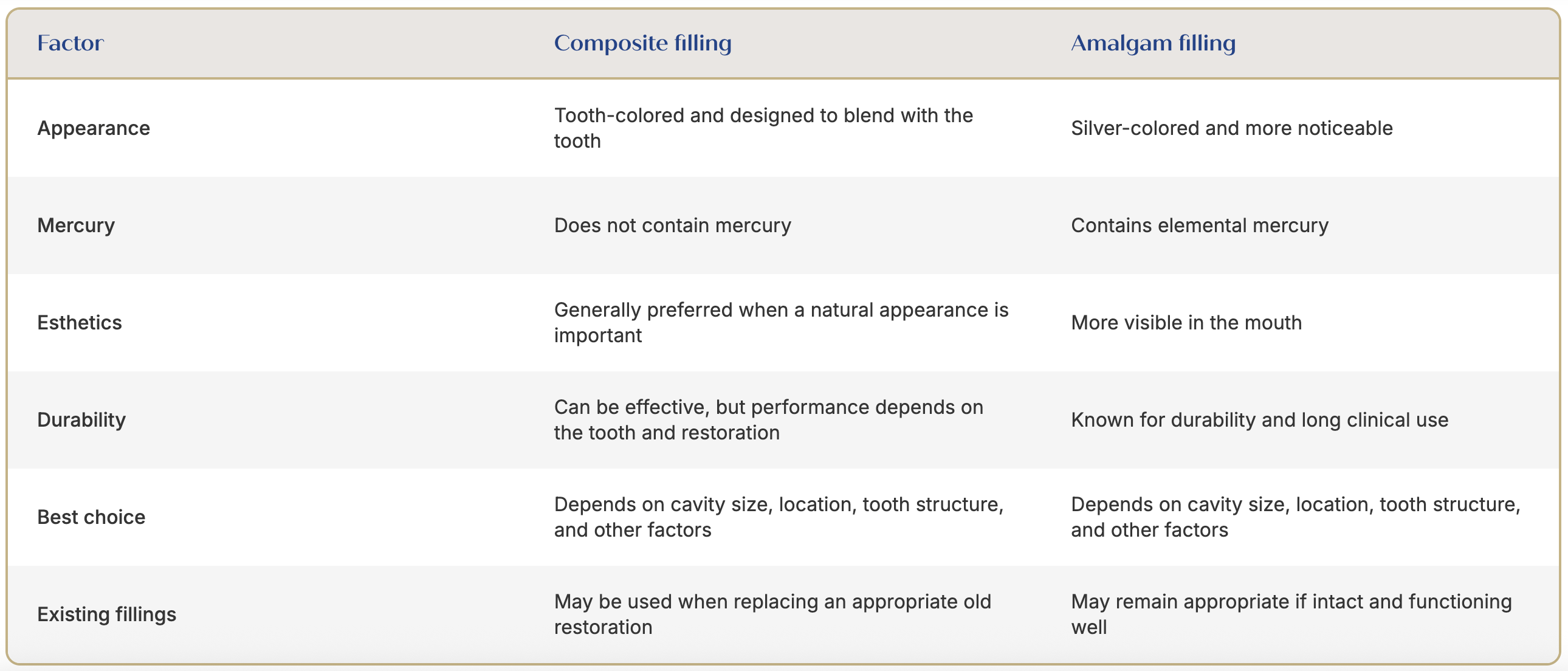
The goal is not to declare a universal winner. A filling is part of a tooth, and the right material depends on the specific situation.
For more information about treatment for damaged or decayed teeth, you can also visit our Restorative Dentistry page.
Who Should Consider Switching From Old Metal Fillings?
If you have older amalgam fillings, a consultation can help determine whether replacement is actually worthwhile.
You may want to discuss replacement if:
- The filling is cracked, broken, worn, or no longer sealing the tooth properly.
- There is decay around or beneath the existing restoration.
- You are concerned about the appearance of a visible silver filling.
- Your dentist identifies a problem with the tooth or restoration during an examination.
- You fall into a group for whom the FDA recommends avoiding amalgam when possible and appropriate.
- You want to understand whether a tooth-colored restoration is a reasonable alternative for a particular tooth.
What you generally should not do is assume that every intact amalgam filling needs to come out simply because it contains mercury. Both the FDA and ADA advise against routine removal of clinically sound amalgam restorations without an appropriate reason.
That is especially important because removing an old filling requires working on the tooth again. If the restoration is still doing its job, leaving it alone may be the more conservative choice.
What Happens During a Fillings Consultation?
A fillings consultation starts with the tooth, not the material.
Your dentist can examine the existing filling and surrounding tooth structure, look for signs of decay or damage, and determine whether replacement is necessary. If replacement is appropriate, the discussion can then turn to which restorative material makes sense.
You can expect the conversation to cover things such as:
- The condition of the existing filling. Is it intact, worn, cracked, or associated with decay?
- The condition of the tooth. How much healthy tooth structure remains?
- The location of the tooth. Front and back teeth can have different functional and cosmetic considerations.
- Available restorative materials. Composite and amalgam have different characteristics.
- Your concerns and preferences. Appearance, mercury concerns, cost, and other considerations can all be part of the discussion.
- The treatment plan. If replacement is appropriate, your dentist can explain what will be removed, what will replace it, and what to expect during the appointment.
If amalgam removal is recommended, the dental team can also use appropriate clinical precautions because mercury vapor exposure can temporarily increase during removal.
Should You Replace Your Old Metal Fillings?
There is no one-size-fits-all answer.
Some people have old amalgam fillings that are still functioning well and do not need to be replaced. Others have restorations that are failing or teeth that would benefit from a different restorative approach.
The important part is separating a legitimate dental need from a general fear about the word "mercury."
If you are wondering whether to replace old metal fillings, an examination can give you a much clearer answer than trying to decide based on appearance or internet claims alone.
Frequently Asked Questions
Are silver fillings safe?
For most people, existing amalgam fillings are considered safe when they are in good condition. The FDA recommends that certain higher-risk groups avoid amalgam when possible and appropriate, and it does not recommend removing intact amalgam fillings unless medically necessary.
Are white fillings better than metal fillings?
Not automatically. Composite fillings offer a tooth-colored appearance and are an alternative to amalgam, but the best material depends on factors such as the tooth's location, the size of the restoration, remaining tooth structure, and individual circumstances.
Should I replace an old silver filling if it does not hurt?
Not necessarily. A filling can have problems without causing pain, so an examination is useful. But if an amalgam restoration is in good condition, the FDA does not recommend removing it simply because it is an amalgam filling.
Does composite filling material contain mercury?
Composite resin fillings do not contain the elemental mercury used in dental amalgam.
Is amalgam the same as the mercury found in fish?
No. Dental amalgam contains elemental mercury. The mercury discussed in connection with many types of seafood is primarily methylmercury, a different chemical form.
Have Questions About an Old Filling?
If you have an old silver filling and are unsure whether it should stay, be replaced, or simply monitored, a fillings consultation can help you understand your options.
The goal is not to replace every metal filling. It is to determine what makes sense for the individual tooth and make a decision based on its condition, your needs, and the available restorative materials.
Book a fillings consultation to have your existing restorations evaluated and discuss whether composite or another restorative option is right for you.
